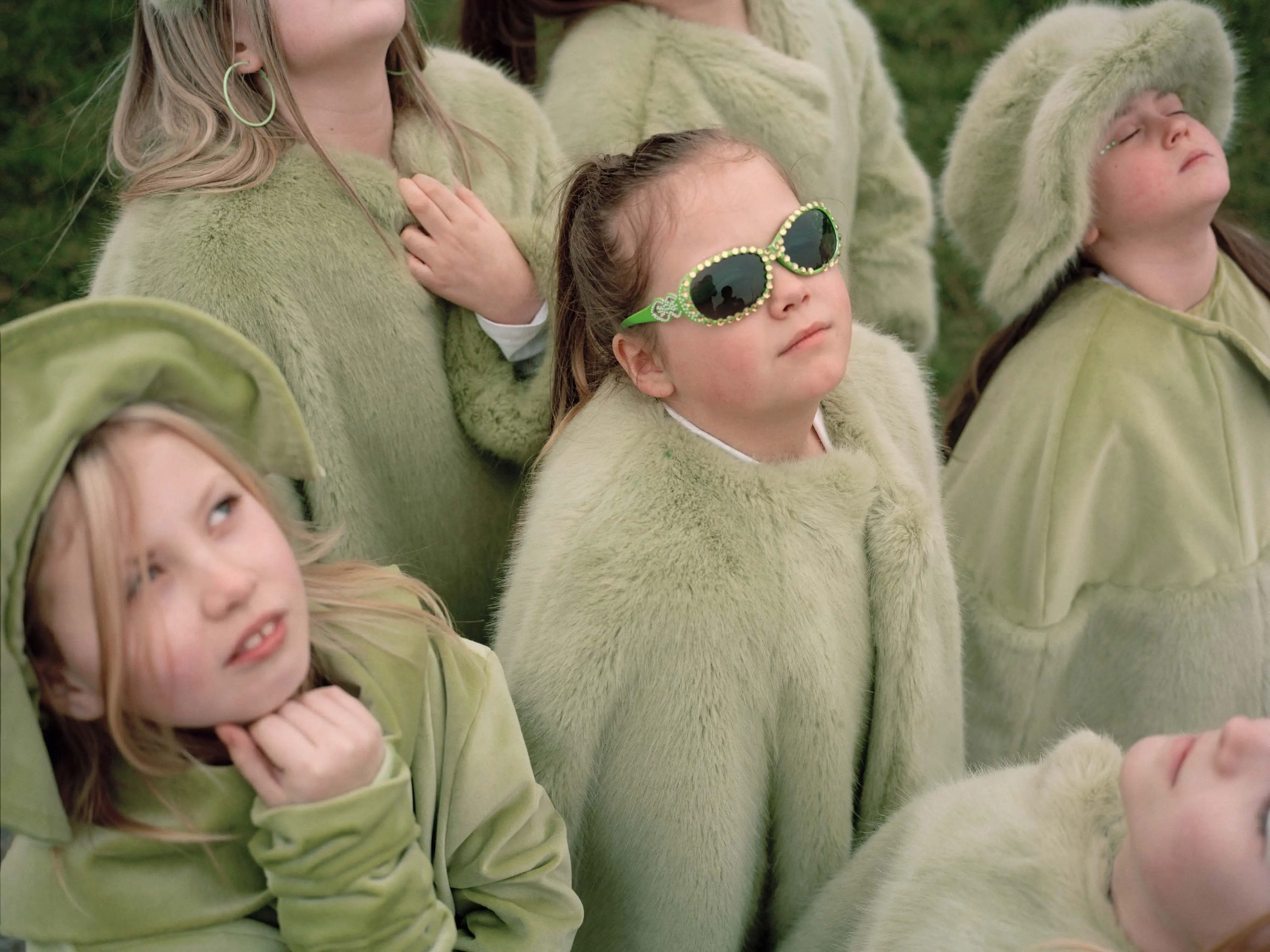
Over the last decade, the photographer Clémentine Schneidermann and the stylist and artistic director Charlotte James have made hundreds of photographs of south Wales Valleys kids and teenagers. But there’s one image—or rather the production of one image—that made them realise ‘there was something magical happening’.
On an overcast day in November 2016, Schneidermann and James ran a workshop at a youth centre in Merthyr Tydfil, where they helped young people to style and customize second-hand clothing and offcut fabrics with sewing machines or by hand. A group of five girls emerged onto the street in head-to-toe black. They wore dresses made of thick velvet or spidery lace. Their heads were adorned with big hats or feathery bonnets, ostentatious and out of time. Some local boys laughed at them as they went by. “What are you wearing?” one of the boys called out. One of the girls, living up to her nickname of Sassy Keely, shouted back, “It’s called fashion…look it up!”

A group portrait from that day takes as its title Sassy Keely’s clapback—which also became the title of the larger series of works Schneidermann and James began creating with Valleys kids in 2015. The girls stand side-by-side, their white faces vivid against the heavy darkness of their clothing and the mottled grey blues of the stone wall behind them (fig. 1). The horizontal lip of the wall splits the picture plane in two halves, so that the composition emphasises the girls’ smallness against the grassed hill and clouded sky. Their diminutive stature is played off against their elaborate dress and idiosyncratic styling: the painted lips in coral 1920s-style cupid bows, the curling tendrils of hair crossing foreheads and cheeks.
The image isn’t without humour, though it doesn’t carry the mockery of the boys’ streetside laughter. A trace of a smile plays about the mouth of the girl on the far right, as if she’s in on a joke we’re not. And in all the girls’ eyes there is an intensity and directness that insists we take them seriously in their outfits, in their poses. It’s called fashion, their eyes say. Look it up.
Some friends of mine have a print of this photograph hanging in their dining room. I’ve looked at it often over a meal or a drink and wondered about how to read the girls’ clothing. The studied formality of their attire sets them apart from the everyday, even as their clothing’s anachronism—the mixing of styles from different eras—casts them adrift from the present. Then there’s the colour, or the lack of it. Schneidermann and James choose colours for different workshops in line with the seasons, like olive in spring or lilac in summer. Yet the black feels gloomy even for the Welsh winter. It feels, I think, almost funereal. But if this is a funeral, what is being grieved? What has been lost?
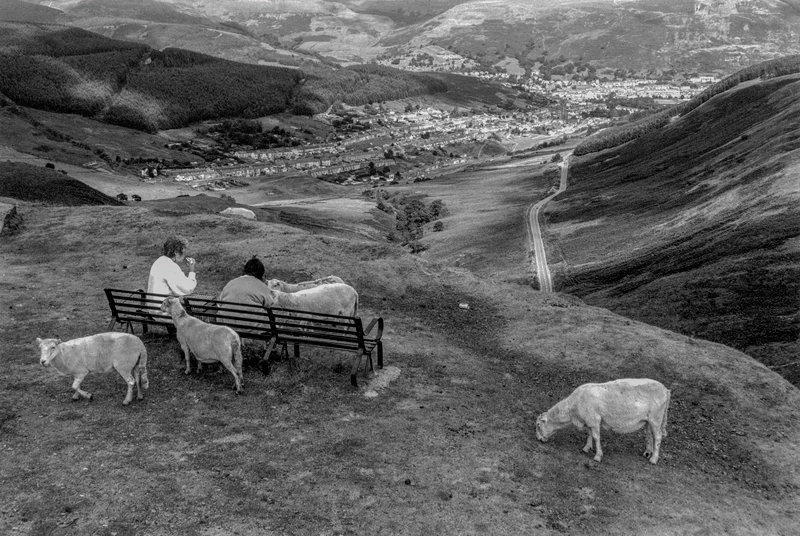
The more I look at this photograph, the more I think I recognise how it speaks back—like Sassy Keely—to a modern history of picturing the Valleys and its people. The region has often been constructed as a melancholy site, a space of mourning and loss. And this has happened principally through photography: from the famous portraits of soot-faced coalminers immortalised in the mid-twentieth century by W. Eugene Smith and Robert Frank to the children of those miners who, later in the century, materialised as solitary or lonely figures in the bleak, black-and-white landscape of becoming-post-industrial Wales. Against this pervasive view of the Valleys from the outside, the girls in black—fashionistas all—stage an ironic memorial for a region that was never so doomed or lifeless as some believed.
The Art of Collaboration
The history of Valleys photography offers examples of a much broader tendency to practice or understand photographic portraiture as a scenario of extraction and objectification. Given the asymmetries of power and vulnerability in the photographer’s relation to those they photograph—the one who sees versus the one who is seen—a photographic portrait can be a thing that is taken from its subject. This is especially true when the person in front of the camera has less cultural or practical power than the person who wields it. Across the history of photography, working-class people and young people have often not been in control of their own photographs. Even in the age of smartphones, studies suggest that a significant number of working-class kids in the UK have only limited access to photographic technologies due to economic injustice.
It’s Called Ffasiwn intervenes in the popular imagination of the Valleys precisely by redressing class-based inequalities of access, resources, and opportunity. By producing the photographs in and through skills-sharing workshops—in costume design, styling, operating the camera, performing before it—James and Schneidermann seek to share creative agency with the young people who appear in the photographs. This is a form of community-based, participatory photography that reimagines portraiture as essentially interactive: a cooperative game, grounded in trust and care, which requires the active involvement of both photographer and photographed.
In fact, It’s Called Ffasiwn equates the art of Schneidermann and James with that of the kids they photograph—and even refuses to differentiate between the two. In the portrait of the girls in black, there’s a dark red rose that serves as the image’s fulcrum. But is the image expertly balanced by the girl’s gesture of sliding the flower over her ear—just one example of the kids’ genius with small, striking details? Or is it secured in the photographer and the stylist’s precise framing of the scene? It is, of course, both at once. Schneidermann and James’ elegant way of composing the world is not merely doubled in but enabled by the kids’ witty, inventive way of being before the camera—and behind it as well.
In stressing the independent existence and creative agency of their subjects, Schneidermann and James’ project bears out a larger trend in contemporary photography and the other arts: to reframe artistic work in terms of reciprocity and exchange between artist and subject. This trend reflects new ways of thinking about the figure of the artist’s model or muse. Conventionally, the model is imagined to be a passive or powerless figure. Even though models always could and did fashion themselves in and for artworks—choosing their clothes, arranging their hair, shaping their poses—they were usually viewed as mere functionaries of the artist’s aesthetic expression. This made the model strangely incidental to the artistic processes in which she (it was usually, and paradigmatically, she) played a pivotal role.
However, in contemporary art, as the scholar Wendy Steiner points out, creative collaboration has emerged as an ‘important theme’, and modelling is increasingly taken to involve ‘communication and equality, as opposed to victimization or subjugation’. In another early portrait from It’s Called Ffasiwn, two girls named Paige and Lydia pose before a glittering, gravel-grey pebbledash wall (fig. 2). One wears a pale pink turtleneck with exaggerated sleeves, the other a bright blue men’s suit jacket and summer hat. Together, they parody gender norms—pink for girls, blue for boys—that both do and don’t fit them, like their oversized or oddly proportioned clothes. Neither looks at the camera: the girl in blue holds down her hat’s floppy brim to cover her downturned face, while the girl in pink looks askance at the camera without quite meeting its gaze. Her inscrutable expression holds onto me without letting me in on her thoughts. And she, like her friend under the hat, uses her clothing in a gesture of withholding, swaddling herself in her long, trailing sleeves.
Paige and Lydia’s modelling is a deliberate, carefully calibrated performance of disclosure and concealment. It’s a choice to be seen and a choice not to be seen.
The Art of the Pose
In reading the signs of the kids’ creative agency in these images, I don’t mean to romanticise this work or suggest that the photographs constitute some pure, egalitarian way of picturing other people. Rather, I see Schneidermann and James working to find practical and aesthetic means to rebalance the power differentials that shape all photographic encounters in the Valleys and beyond—and to foreground the forms of agency that exist in fashioning the self through clothing and photographs.
The creative labour of modelling is a central theme in a series of portraits of young people in Blaenau Gwent that Schneidermann made in parallel to It’s Called Ffasiwn from 2015–2018. In ‘Aicha, Coed Cae’, a young girl in a fur-trimmed vest, a shiny pink circle skirt, and long striped socks sits on a chair in a makeshift studio in a community hall (fig. 3). Her backdrop is a large sheet of what appears to be pink canvas, or perhaps coated paper, which unspools from a visible frame. The girl is buffered by space on all sides, the camera’s wide view taking in the plaque on the wall, the limp British flag, the fire extinguisher.
The photograph is a scene of its own making—and that making is not accidental or haphazard, even if the image incorporates objects that might track as visual clutter. In the near match of the girl’s skirt and the backdrop, the clean, horizontal lines of paint on the wall, and the squares of coloured light whose dance animates the space, the photograph is virtuosic in its stylishness. That stylishness is also, patently, Aicha’s, as she looks into the camera, head slightly cocked. Her frank, nonchalant expression is just as artful as her surroundings.
In ‘Shelby, Swffryd’, the central figure is supplied her pink backdrop by another kid, who stands behind her holding up a square of material (fig. 4). As in ‘Aicha, Coed Cae’, the backdrop is like a magic trick revealed, but here its broken illusion appears more amateurish. The fabric flaps in the wind and we can see the fingers of the kid who holds it at its corners. We can see her sneakers, too, their neon flashing from behind Shelby’s Converse shoes. Shelby’s looser posture, with her hanging arms and her slightly jutting neck, also reads as less controlled than Aicha’s.
These aspects of the image, along with the rubbish-strewn outdoor setting, might make it seem more equivocal than ‘Aicha, Coed Cae’ in assigning artistry to its subjects. Yet the opposite might be true. After all, this image demonstrates how essential the kids are to the creation of these portraits—especially when we recognise their performances before the camera as a form of creative labour. If there’s ‘something magical’ about Schneidermann and James’ photographs of Valleys kids, then, it’s in the agency the kids exert in co-producing their portraits. It’s in their acts of making themselves both seen and unseen, whether holding the pose or holding the fabric.
Alix Beeston is a writer and academic based in Cardiff, Wales. Her next book, a critical–creative account of women and girls in photography history, will be published by Penn State University Press in 2027.